LiFePO4 Battery Buying Guide for Canadians
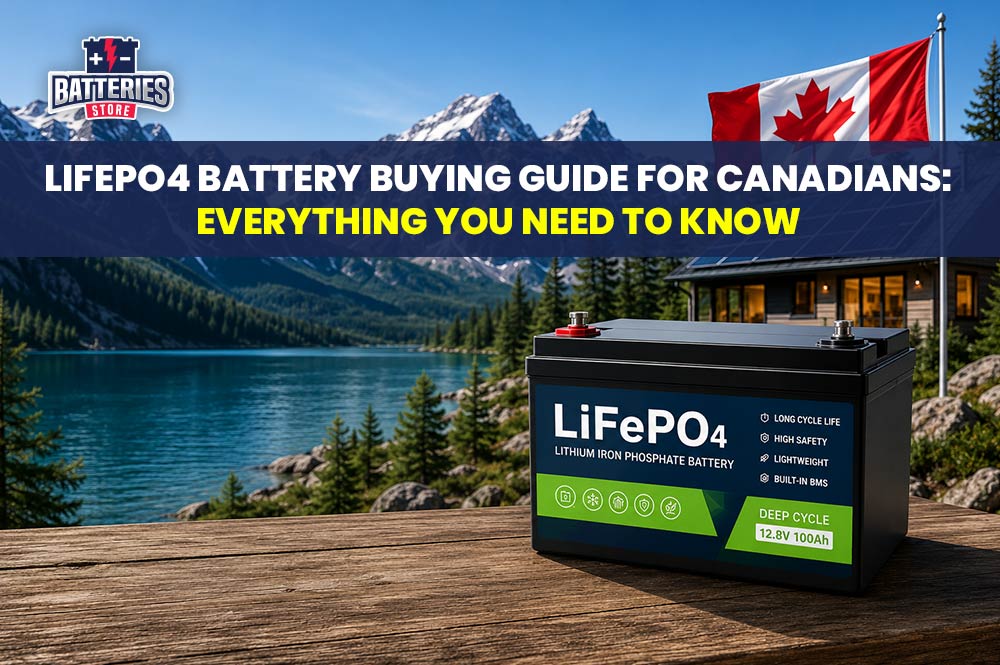
A LiFePO4 Battery is one of the safest, most durable, and most efficient battery technologies available to Canadian buyers today. Whether you are powering a solar system, an RV, a boat, or a mobility scooter, LiFePO4 lithium batteries offer a significant upgrade over traditional lead-acid options. This guide explains everything you need to know before buying a LiFePO4 battery in Canada, from understanding capacity and chemistry to choosing the right model for cold-weather performance.
The term LiFePO4 stands for Lithium Iron Phosphate. This chemistry has become the dominant choice for off-grid energy storage, recreational vehicles, and backup power systems across Canada. Therefore, understanding how it works will help you make a confident, informed purchase.
What Is a LiFePO4 Battery?
A LiFePO4 battery uses lithium iron phosphate as its cathode material. This specific chemistry makes it fundamentally different from standard lithium-ion batteries found in laptops and smartphones.
The iron-phosphate bond in LiFePO4 is chemically stable, which means the battery does not overheat, catch fire, or enter thermal runaway under normal use conditions. This makes it one of the safest lithium battery chemistries available to consumers.
Also, LiFePO4 batteries maintain a relatively flat discharge voltage curve. In practical terms, this means your equipment receives consistent power throughout the discharge cycle, rather than slowing down gradually as the battery depletes.
LiFePO4 Battery vs. Other Battery Types: How Does It Compare?
Understanding how a LiFePO4 battery compares to its alternatives helps clarify why so many Canadian buyers are making the switch. The two most common comparisons are against AGM lead-acid batteries and standard lithium-ion (NMC or NCA) batteries.
LiFePO4 vs. AGM
AGM batteries are a sealed lead-acid technology and have been the standard for off-grid and deep cycle applications for decades. However, LiFePO4 batteries outperform AGM in almost every measurable category.
A 12V LiFePO4 battery can be safely discharged to 80 to 100 percent of its rated capacity. In contrast, an AGM battery should only be discharged to 50 percent to avoid permanent plate damage. This means a 12V 100Ah LiFePO4 battery effectively delivers roughly double the usable energy of an equivalent 12V 100Ah AGM battery.
LiFePO4 batteries also weigh approximately half as much as AGM batteries of the same capacity and last four to ten times longer in terms of charge cycles.
LiFePO4 vs. Standard Lithium-Ion
Standard lithium-ion batteries, such as Nickel Manganese Cobalt (NMC) and Nickel Cobalt Aluminium (NCA) chemistries, offer slightly higher energy density than LiFePO4. However, they are significantly less thermally stable.
LiFePO4 batteries do not produce the same thermal runaway risk as NMC or NCA chemistries. Therefore, they are the preferred choice for stationary and vehicular energy storage where safety is a priority. Also, LiFePO4 batteries handle thousands more charge cycles than NMC types.
| Feature | Flooded Lead-Acid | AGM | Standard Lithium-Ion | LiFePO4 Battery |
| Cycle Life | 200–300 | 400–600 | 500–1,000 | 2,000–5,000+ |
| Usable Capacity | ~50% | ~50% | ~80% | ~80–100% |
| Weight (relative) | Very Heavy | Heavy | Light | Light |
| Safety | Good | Good | Moderate | Excellent |
| Cold Performance | Poor | Fair | Fair | Good (with BMS) |
| Maintenance | High | None | None | None |
| Typical Lifespan | 1–2 yrs | 3–5 yrs | 3–5 yrs | 8–15 yrs |
Key Benefits of a LiFePO4 Battery for Canadian Users
Canadian conditions place unique demands on batteries. Harsh winters, remote locations, and long distances from service centres make battery reliability and longevity especially important. Here is why LiFePO4 batteries are a strong fit for Canadian users specifically.
Longer Lifespan: Most LiFePO4 batteries last 2,000 to 5,000 charge cycles. For an everyday user, this translates to 10 or more years of reliable service.
More Usable Capacity: Because LiFePO4 batteries can be discharged to 80 to 100 percent depth, you get significantly more usable energy from each unit.
Lightweight Design: A LiFePO4 battery weighs roughly half as much as an equivalent AGM. This matters greatly for RVs, boats, and portable solar systems.
Zero Maintenance: LiFePO4 batteries are completely sealed and require no water top-ups, terminal cleaning, or equalization charges.
Fast Charging: LiFePO4 batteries accept charge much faster than lead-acid types. A 12V 100Ah LiFePO4 can fully charge in 2 to 4 hours with an adequate charger.
Built-in Safety: The iron-phosphate chemistry does not overheat or catch fire under normal operating conditions, even if overcharged briefly.
How a 12V LiFePO4 Battery Works
A 12V LiFePO4 battery contains multiple lithium iron phosphate cells connected in series. Most 12-volt packs use four 3.2-volt cells wired in series, producing a nominal voltage of 12.8 volts.
The battery also includes a built-in Battery Management System, or BMS. The BMS monitors individual cell voltages, temperature, charge current, and discharge current. It actively protects the battery from overcharge, over-discharge, short circuit, and temperature extremes.
This protection circuit is what makes a quality LiFePO4 lithium battery both safe and long-lasting. A battery without a BMS, or with a poor-quality BMS, will degrade rapidly and may pose a safety risk. Therefore, always confirm BMS specifications before purchasing.
What Capacity Do You Need? Understanding Ah Ratings
The Amp-Hour (Ah) rating of a LiFePO4 battery describes how much energy it can store. A 12V 100Ah LiFePO4 battery stores 1,200 watt-hours of energy at 12 volts.
However, the real-world usable energy depends on your maximum depth of discharge. Because LiFePO4 batteries support 80 to 100 percent depth of discharge, a 12V 100Ah LiFePO4 delivers 960 to 1,200 watt-hours of usable energy. An equivalent AGM delivers only 600 watt-hours due to its 50 percent discharge limit.
When sizing your battery bank, first calculate your daily energy consumption in watt-hours. Divide by 12 to convert to amp-hours. Then multiply by the number of days of autonomy you want without recharging.
| Daily Energy Use | Autonomy Needed | Recommended LiFePO4 Capacity | Typical Application |
| 300–500 Wh | 1–2 days | 12V 50Ah | Small cabin, camping kit |
| 500–800 Wh | 1–2 days | 12V 100Ah | RV weekend use, small solar |
| 800–1,500 Wh | 2–3 days | 12V 200Ah or 2x 100Ah | Full-time RV, off-grid cabin |
| 1,500–3,000 Wh | 3+ days | 4x 12V 100Ah or 2x 200Ah | Large cabin, solar home bank |
Top Applications of LiFePO4 Batteries in Canada
LiFePO4 lithium batteries are used across a wide range of applications in Canada. Their versatility, safety, and long lifespan make them suitable for both stationary and mobile power systems.
Solar and Off-Grid Power Systems
Solar energy storage is the single largest application for LiFePO4 batteries in Canada. They store energy generated during daylight hours and release it at night or during cloudy periods.
A 12V LiFePO4 battery bank pairs efficiently with MPPT solar charge controllers and modern pure-sine wave inverters. Also, LiFePO4 batteries charge more efficiently from solar panels than lead-acid types, wasting less energy as heat during the absorption phase.
RV and Camper Van House Banks
Canadian RVers love LiFePO4 batteries for their house banks. The lighter weight reduces vehicle load, the faster charging maximizes time spent away from shore power, and the higher usable capacity means running appliances longer between charges.
A 12V 100Ah LiFePO4 battery is the most popular single-unit choice for small to medium travel trailers and camper vans. Larger Class A and Class C motorhomes typically use two or more units in parallel.
Marine and Boat Applications
Marine environments are demanding. Constant vibration, moisture, and salt air stress every component on a boat. LiFePO4 batteries handle vibration better than lead-acid types and their sealed construction resists moisture ingress.
Also, the lighter weight of a LiFePO4 battery significantly improves boat stability and fuel efficiency compared to heavier lead-acid alternatives.
Mobility Scooters and Electric Vehicles
LiFePO4 batteries extend the practical range of mobility scooters and power wheelchairs. Their flat discharge curve means consistent motor performance throughout the full charge cycle, and their longer cycle life reduces replacement frequency and total lifetime cost.
How LiFePO4 Batteries Perform in Canadian Winter
Cold weather performance is one of the most common concerns Canadian buyers raise about LiFePO4 batteries. The answer is nuanced and depends heavily on the quality of the BMS.
LiFePO4 batteries discharge well in cold temperatures, typically down to -20°C with only moderate capacity reduction. However, charging a LiFePO4 battery below 0°C can permanently damage the lithium cells through a process called lithium plating.
This is why a quality BMS includes a low-temperature charge protection circuit. When the battery temperature drops below 0°C, the BMS automatically blocks incoming charge current to protect the cells. Some premium LiFePO4 batteries also include a self-heating function that warms the cells before accepting a charge in sub-zero conditions.
Canadian Winter Tip: Look for a LiFePO4 battery rated for discharge at -20°C or lower with BMS-controlled low-temperature charge protection. If you operate your system in -30°C conditions, such as in northern Alberta or Saskatchewan, choose a model with active self-heating.
| Temperature | LiFePO4 Discharge Capacity | Charging Allowed? | AGM Discharge Capacity |
| 25°C (Room Temp) | 100% | Yes | 100% |
| 0°C | ~90–95% | Yes (slower) | ~85% |
| -10°C | ~85% | BMS Protection | ~65% |
| -20°C | ~75% | BMS Blocks Charge | ~50% |
| -30°C | ~60% | BMS Blocks Charge | ~30% |
What to Look for When Buying a LiFePO4 Battery in Canada
Not all LiFePO4 batteries are equal. Several critical specifications separate a long-lasting, safe battery from a low-quality unit that may fail prematurely or pose a risk.
Built-In Battery Management System (BMS)
The BMS is arguably the most important component in any LiFePO4 lithium battery. A quality BMS protects against overcharge, over-discharge, over-current, short circuit, and temperature extremes.Always check the BMS continuous discharge current rating. It must meet or exceed the maximum current your application draws. For example, an inverter capable of 1,000 watts at 12 volts draws approximately 83 amps. Your BMS must support at least this continuous discharge rate.
Cycle Life and Warranty
A genuine quality LiFePO4 battery should be rated for at least 2,000 cycles at 80 percent depth of discharge. Premium units reach 3,000 to 5,000 cycles. Ask the seller for the cycle life specification at the depth of discharge you plan to use.
Also, check the warranty carefully. A reputable LiFePO4 battery sold in Canada should carry at least a two-year warranty. CANBAT batteries available at Batteries Store Canada come with documented cycle life ratings and manufacturer support.
Cold-Temperature Rating
As discussed, this specification is essential for Canadian buyers. Confirm the minimum operating temperature for both charging and discharging. Look specifically for low-temperature charge cutoff protection in the BMS, and consider self-heating models for extreme cold environments.
How to Charge a LiFePO4 Lithium Battery Correctly
Charging a LiFePO4 battery correctly is straightforward, but it does require a compatible charger. Do not use a charger designed for lead-acid batteries without first confirming it has a selectable LiFePO4 charge profile.
LiFePO4 batteries use a CC-CV (Constant Current – Constant Voltage) charge method. The correct charging voltage is 14.4 to 14.6 volts for a 12V LiFePO4 battery. Lead-acid chargers typically use 14.7 to 15.0 volts, which can stress LiFePO4 cells over time.
Most modern multi-stage smart chargers include a selectable LiFePO4 mode. MPPT solar charge controllers also support LiFePO4 charge profiles and should be configured accordingly when charging from solar panels.
Avoid letting your LiFePO4 battery sit fully discharged for extended periods. The BMS will disconnect the battery before it reaches a damaging low voltage, but storing a fully depleted battery for months can cause cell damage that is difficult to reverse.
How Long Does a LiFePO4 Battery Last?
A well-maintained LiFePO4 battery typically lasts 8 to 15 years in regular use. This estimate assumes approximately 80 percent depth of discharge per cycle and proper charging practices.
The cycle life of 2,000 to 5,000 cycles translates to years of real-world use depending on how frequently you cycle the battery. For example, cycling a LiFePO4 battery once per day at 80 percent depth gives a lifespan of roughly 5 to 13 years at 2,000 to 5,000 cycles.
Contrast this with an AGM battery cycled daily, which typically lasts only 1 to 3 years. Therefore, the higher initial cost of LiFePO4 batteries delivers significantly lower cost per cycle over time.
| Battery Type | Cost (approx.) | Cycle Life | Cost Per Cycle (est.) |
| AGM 12V 100Ah | $180–$250 | 400–600 cycles | $0.38–$0.56 per cycle |
| LiFePO4 12V 100Ah | $400–$700 | 2,000–5,000 cycles | $0.08–$0.25 per cycle |
Shop LiFePO4 Batteries at Batteries Store Canada
Batteries Store Canada carries a comprehensive range of 12V LiFePO4 batteries, including both in-house and CANBAT-branded units. All products are available in-store in Calgary, Regina, and Red Deer, and through our online shop at batteriesstore.ca.
12V 100Ah LiFePO4 Battery (Standard)
The most popular LiFePO4 battery for Canadian RVers, off-grid solar users, and marine applications. Reliable, maintenance-free, and ready for drop-in replacement in most 12-volt systems.
12V 100Ah Lithium Battery (LiFePO4) - Our bestselling 12V 100Ah LiFePO4 battery.
Explore more LiFePO4 batteries here.
Not sure which LiFePO4 battery is right for your setup? Visit Batteries Store in Calgary, Regina, or Red Deer and our team will help you calculate the right capacity and confirm compatibility with your existing charger, solar controller, and inverter.
Conclusion: Is a LiFePO4 Battery Right for You?
A LiFePO4 battery is the right choice for most Canadian buyers who need reliable, long-lasting, and safe energy storage. It delivers more usable capacity, a longer lifespan, and better safety than any comparable lead-acid battery, and it outperforms standard lithium-ion in terms of cycle life and thermal stability.
For solar systems, RVs, boats, mobility scooters, and off-grid cabins across Canada, LiFePO4 lithium batteries offer the best long-term value despite their higher upfront cost. The lower cost per cycle, reduced maintenance, and dramatically longer service life make the investment worthwhile for anyone who depends on their battery system regularly.
Visit Batteries Store Canada in Calgary, Regina, or Red Deer to browse our full LiFePO4 battery range and speak with our team about the right capacity, model, and setup for your specific needs. You can also shop online anytime at batteriesstore.ca.
Frequently Asked Questions About LiFePO4 Batteries
Is a LiFePO4 battery safe to use indoors?
Yes. LiFePO4 batteries do not off-gas hydrogen under normal operating conditions, making them safe to use in enclosed spaces like RV cabins, van builds, and indoor solar setups. This is a significant advantage over flooded lead-acid batteries, which require ventilation.
Can I replace my AGM battery with a LiFePO4 battery directly?
In most cases, yes. A 12V LiFePO4 battery is a physical drop-in replacement for a 12V AGM in the same group size. However, you must update your charger or solar controller to use a LiFePO4 charge profile. Charging with an AGM profile will not damage the LiFePO4 immediately, but it will reduce long-term performance and lifespan.
Can I connect multiple LiFePO4 batteries together?
Yes. LiFePO4 batteries can be wired in parallel to increase amp-hour capacity while maintaining 12 volts, or in series to increase voltage while maintaining the same amp-hour capacity. Always use batteries of the same brand, capacity, and age in a parallel bank for best results.
What is the difference between a 12V LiFePO4 battery and a 12V lithium-ion battery?
The chemistry is different. LiFePO4 (Lithium Iron Phosphate) is a specific type of lithium battery known for its thermal stability and long cycle life. Standard lithium-ion batteries, such as those in phones and laptops, use NMC or NCA chemistry, which has higher energy density but lower thermal stability and fewer charge cycles.
How should I store a LiFePO4 battery over winter?
Store your LiFePO4 battery at approximately 50 percent state of charge in a temperature-controlled location above 0°C. Check and top up the charge to 50 percent every three months during storage. Avoid storing at full charge or zero charge for extended periods.
Do LiFePO4 batteries need a special charger?
Yes. You should use a charger with a LiFePO4 charge profile set to 14.4 to 14.6 volts for 12V systems. Many modern multi-stage smart chargers include this setting. Standard lead-acid chargers may work temporarily but are not recommended for long-term use with LiFePO4 batteries.